Digital Manufacturing & Smart Equipment: The Next Wave of Sports Product Innovation
If you have any product customization needs or ideas, MOQ 500, contact us.
Jul. 22, 2026
The sports equipment industry is undergoing a structural transformation. Digital manufacturing technologies — 3D printing, CNC machining, AI-driven design, and smart sensor integration — are reshaping how products are developed, produced, and used.
For B2B buyers, this shift creates both opportunities and new requirements. The question is no longer "can you make this product" but "how quickly can you customize it, how smart can you make it, and how reliably can you deliver it at scale."
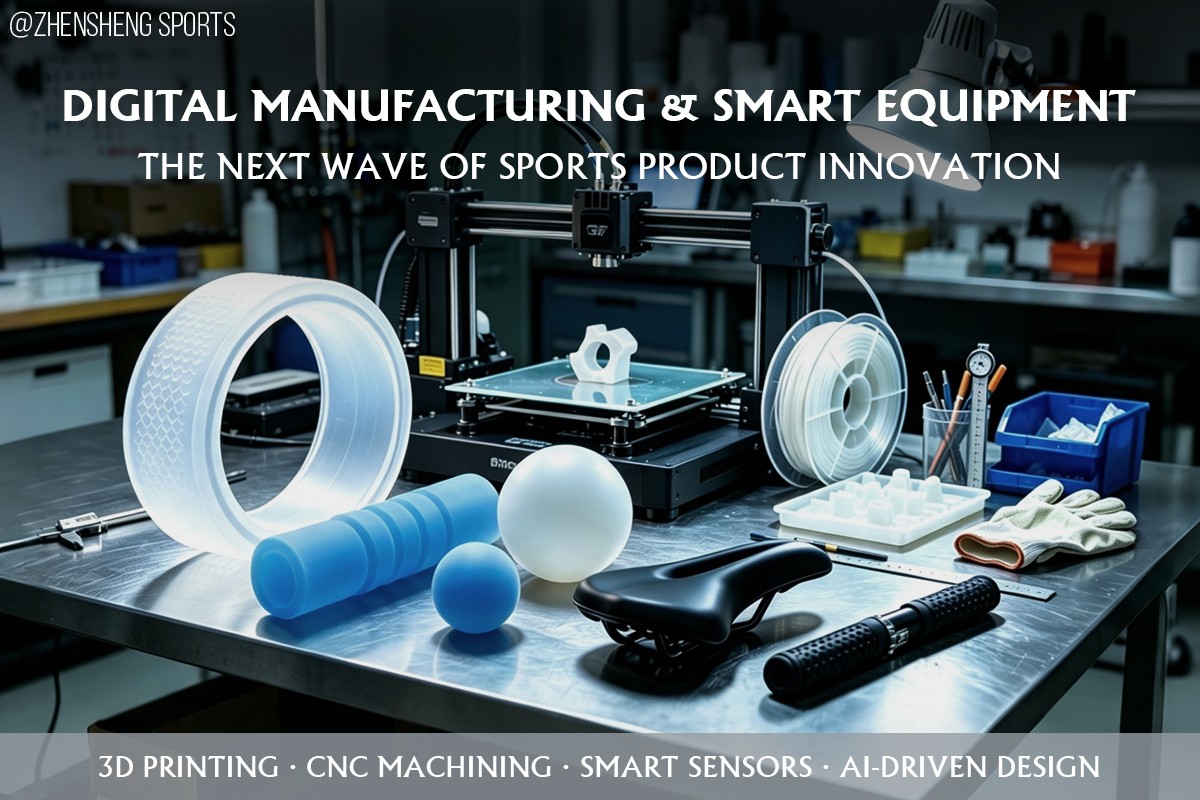
Digital manufacturing is not a future trend — it is already reshaping production across the sports equipment industry. AI, IoT, 3D printing, digital twins, and flexible manufacturing are being deployed across fitness equipment, ball manufacturing, sports flooring, outdoor gear, and rehabilitation products.
In ball manufacturing, for example, automated cutting systems now cut 32 panels from a single sheet in one pass, replacing manual die-cutting. Digital printing has replaced 15-step screen-printing processes. Each panel receives a unique QR code for full traceability, enabling complete quality tracking from raw material to finished product.
In fitness equipment manufacturing, the impact is equally significant. Leading manufacturers have implemented welding robots and laser cutting systems alongside MES (Manufacturing Execution Systems) that collect and analyze production data in real time. One Chinese fitness equipment manufacturer reported a 70% reduction in defect rates and doubled production efficiency after digitizing their production lines.
For B2B buyers, these manufacturing capabilities matter because they translate directly into faster sampling, more consistent quality, and greater flexibility in order sizes.
3D printing has moved from prototyping to production. The technology enables levels of customization that were previously impossible or prohibitively expensive.
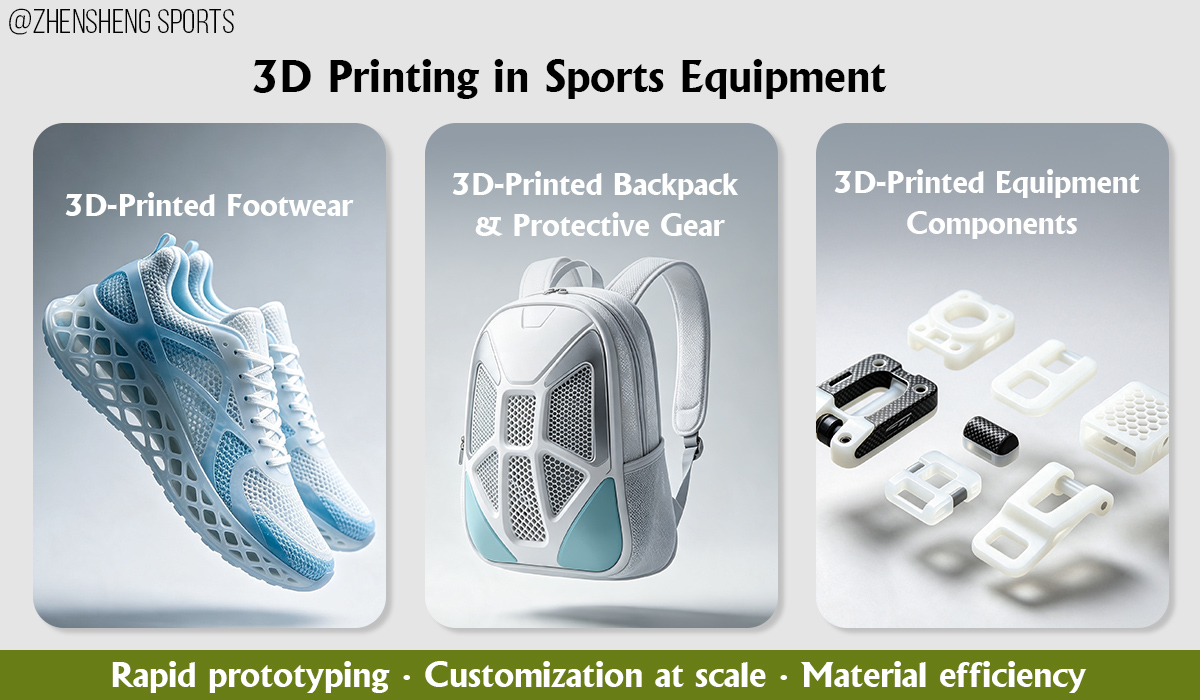
At the 2025 National Games, 3D-printed footwear and backpacks debuted as part of official team equipment. Using high-speed stereolithography 3D printing with bio-based elastomer materials, the shoes were manufactured as single-piece structures with lattice designs — lightweight, resilient, and high-rebound.
The backpack featured a 3D-printed AirBuff breathable module with a bionic lattice structure that replaced traditional foam padding, enabling "structural ventilation" that allows air to circulate freely between the wearer's back and the pack. The entire module was printed as a single piece, eliminating adhesives and seams .
For sports equipment buyers, 3D printing offers several advantages:
Rapid prototyping: Design-to-delivery cycles as short as 72 hours, compared to weeks for traditional tooling
Customization at scale: Individualized fit and performance tuning without significant cost premiums
Material efficiency: Additive manufacturing reduces waste compared to subtractive processes
Complex geometries: Lattice structures and organic forms that are impossible with traditional manufacturing
The 2025 National Games torch also utilized 3D printing for its petal structures, using stainless steel that withstands temperatures exceeding 1,000°C. The internal design incorporated three-layer insulation to maintain handheld temperature below 37°C, illustrating how 3D printing can solve both aesthetic and functional engineering challenges.
According to market analysis, the global smart sports equipment market is projected to grow from $3.62 billion in 2026 to $7.65 billion by 2034, at a CAGR of 9.8%. North America currently dominates, while Asia Pacific is the fastest-growing region at a CAGR of 13.2%.
Smart equipment represents the convergence of hardware and software in sports products. Traditional equipment is being enhanced with embedded sensors, connectivity, and data analytics capabilities.
Major brands are already commercializing connected ball technology. Adidas introduced a match ball with an IMU sensor stabilized via a patented suspension system, communicating with field antennas to relay real-time data on ball position and velocity. This technology supports faster officiating decisions and enables advanced training and broadcast analytics.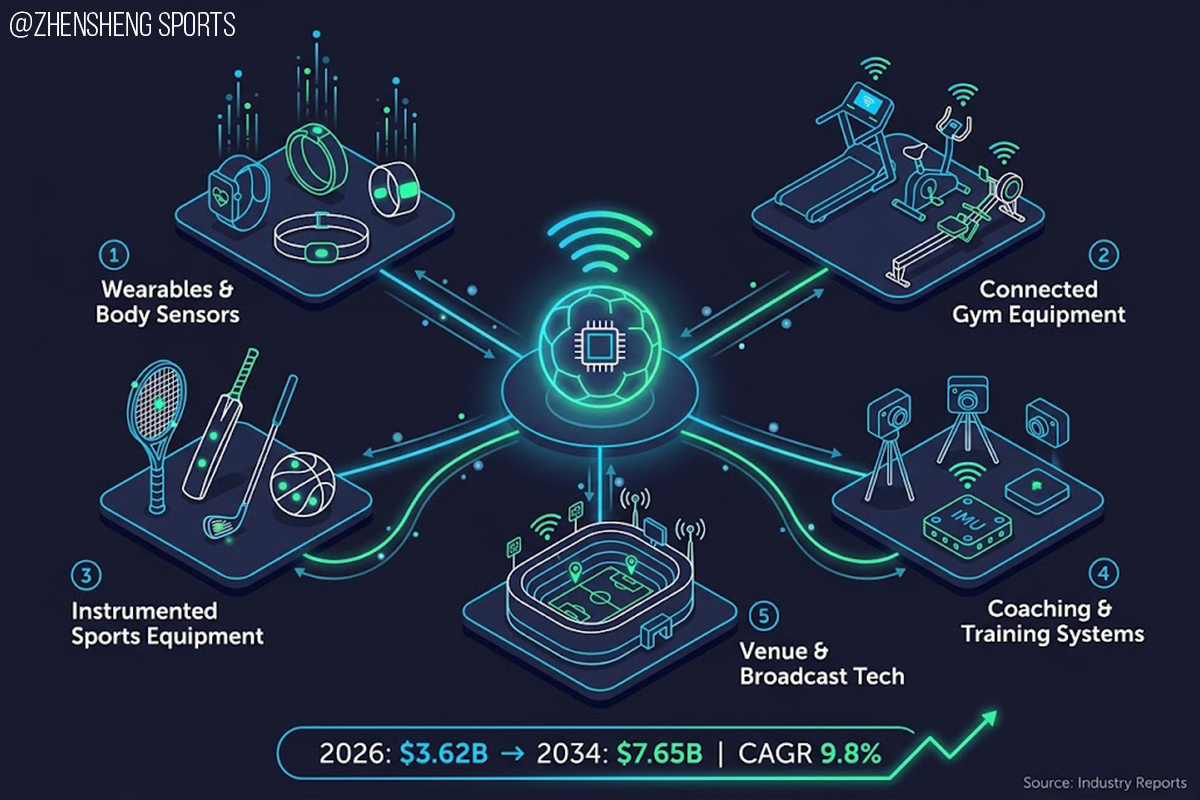
The smart sports equipment market ecosystem includes:
Wearable devices: Smart bands, sport watches, rings, chest straps
Connected fitness equipment: Smart bikes, treadmills, rowers, weight machines
Instrumented sports equipment: Smart balls, rackets, bats, clubs, smart footwear
Stadium and venue systems: Player tracking, smart pitch/field sensors, camera and sensor rigs
Coaching and training hardware: Motion-capture sensors, IMU arrays, markerless tracking units
The integration of edge AI and embedded firmware is a key growth area. On-device AI processes data locally, enabling real-time coaching, fatigue detection, and automated technique analysis without requiring constant cloud connectivity. This capability transforms sports equipment from passive tools into active training partners.
For OEM buyers, smart equipment presents new considerations. Component sourcing expands to include sensors, batteries, and connectivity modules. Quality control must address both hardware performance and firmware reliability. Compliance requirements increasingly include wireless certification and data privacy standards.
One of the most significant impacts of digital manufacturing is the ability to offer customization without sacrificing efficiency.
Traditional manufacturing required large production runs to justify tooling costs. Digital manufacturing changes this equation. CNC machining and 3D printing reduce or eliminate tooling requirements, enabling smaller batch sizes and quicker changeovers. ERP and MES systems coordinate production planning and inventory, reducing manual intervention and error [citation:1].
In outdoor equipment manufacturing, some companies now use 3D scanning and 3D printing to produce custom protective gear and supports. By digitally modeling individual user body data, they can produce personalized products at scale — achieving both "mass production" and "mass customization" simultaneously.
These capabilities are increasingly important to B2B buyers who need to differentiate their product lines and respond to niche market demands. The ability to offer customized products without long lead times or minimum order quantities is becoming a competitive differentiator.
ZhenSheng is positioned to support buyers navigating this transition. With over 22 years of manufacturing experience across yoga mats, resistance bands, protective gear, and other fitness accessories, we are adapting our capabilities to meet the demands of digital manufacturing.
Customization and Fast Sampling: We support low MOQs and rapid sampling for custom products. Our engineering team can translate concepts into manufacturable designs, with sample lead times as short as 7-15 days for custom projects.
Multiple Material Capabilities: We work with a wide range of materials — TPE, PVC, natural rubber, leather, nylon, cork — enabling customers to select the right material for their specific application.
Quality Documentation: Our 3-stage QC process (IQC/IPQC/OQC) is supported by full documentation, including REACH, Prop65, and BSCI compliance. For smart equipment projects, we can work with customers to incorporate sensors and connectivity components while maintaining quality standards.
Supply Chain Integration: One window, multiple categories. Customers can source yoga mats, resistance bands, protective gear, and more from a single partner, reducing vendor management complexity.
Digital manufacturing and smart equipment are not separate trends — they are converging to reshape the sports equipment industry. The same technologies that enable rapid prototyping and customization also power the data-driven products that athletes and consumers increasingly expect.
For B2B buyers, the implications are clear. The traditional sourcing model — long lead times, high MOQs, limited customization — is being replaced by more flexible, responsive, and technology-enabled partnerships.
Whether you are developing a custom yoga mat, a smart resistance band with integrated sensors, or a next-generation protective gear line, the capabilities that matter are rapid sampling, material expertise, quality compliance, and supply chain integration.
Contact us to discuss how we can support your next digital manufacturing or smart equipment project.
Search Blog
New Products
E-mail: info@shzhensheng.com
:
Tel.: +86 21 5204 8758
Add.: Room 203, Building 1, No. 423 Wuning Road, Putuo district, Shanghai 200063, China
Navigation
Get in touch
seoKeywords: custom size yoga mat custom logo yoga mat custom Rubber Pilates Yoga Mat eco friendly rubber yoga mat custom Pilates Yoga Mat TPE Rubber Professional Yoga Mat rectangle yoga mat tpe comfortable tpe yoga mat comfortable tpe yoga mat Customize nbr yoga mat custom round yoga mat round yoga mats wholesale eco friendly yoga mats wholesale non slip yoga mat wholesale Customize non slip yoga mat wholesale ankle weights wholesale custom round yoga mat round yoga mats wholesale personalized soccer ball size 5 personalized soccer ball size 4 Thermo Bonded Football Machine Stitched Football custom resistance bands wholesale wholesale resistance bands with logo custom printed resistance bands custom logo resistance bands custom size resistance bands custom length resistance bands custom ankle weights ankle weights cost ankle weights cost buy ankle weights custom balance board surf balance board oem yoga mat yoga mat factory yoga mat manufacturer tpe yoga mat manufacturer private label yoga mats