Sports Equipment Market Mid-Year Review 2026
If you have any product customization needs or ideas, MOQ 500, contact us.
Jul. 30, 2026
2026 is shaping up to be a defining year for the global sports equipment industry. With the FIFA World Cup driving demand, shifting consumer behaviors, and macroeconomic pressures reshaping supply chains, the first half of the year has set a clear trajectory for the months ahead.
This mid-year review examines the key trends, growth segments, and what they mean for B2B buyers planning their H2 procurement strategies.
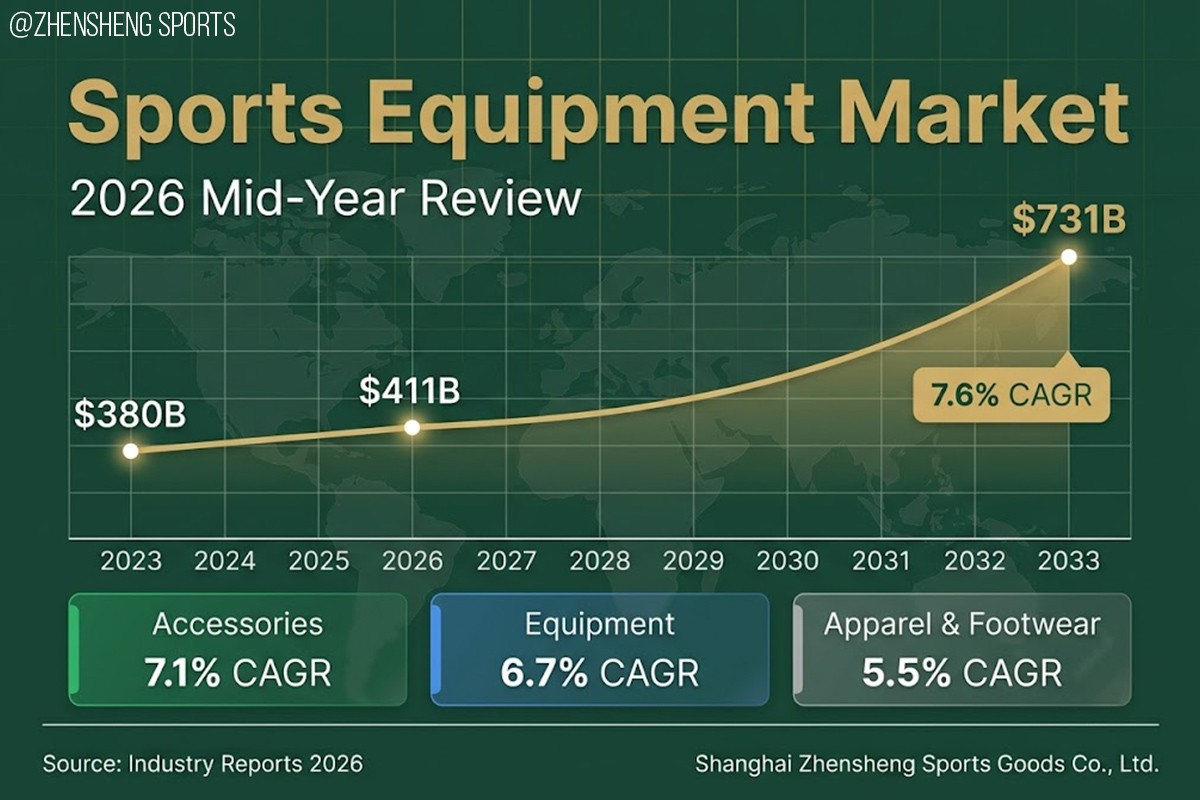
The global sports equipment market is growing at an accelerated pace. Several structural forces are driving this expansion: rising health consciousness, increasing participation in racket sports (particularly pickleball), the integration of smart technology into fitness equipment, and the continued expansion of outdoor recreation.
| Metric | Value | Notes |
|---|---|---|
| 2025 Global Market Value | $411 billion | Baseline year |
| 2033 Projected Value | $731 billion | CAGR 7.6% |
| U.S. Market 2025 | $32.1 billion | Largest national market |
| U.S. Market Projected 2031 | $45.4 billion | 6% CAGR |
The 2026 FIFA World Cup is the single largest sporting event of the year. China's ball exports reached 3.08 billion RMB in H1 2026, driven largely by World Cup-related demand. The Latin American market grew by 18.9% year-over-year.
| Metric | Value |
|---|---|
| China Ball Exports (H1 2026) | 3.08 billion RMB |
| Latin American Market Growth (YoY) | 18.9% |
Accessories are emerging as the standout performer. Short replacement cycles, broader use cases, and lower barriers to entry are driving sustained demand.
| Category | Projected CAGR |
|---|---|
| Accessories | 7.1% |
| Equipment | 6.7% |
| Apparel & Footwear | 5.5% |
Protective gear continues to see consistent demand driven by strength sports participation, an aging population, and the fastest-growing end-user segment: women.
| Segment | Growth Rate |
|---|---|
| Women's Participation (U.S.) | 7.8% CAGR |
| Protective Gear | Steady growth |
Lightweighting is no longer a niche trend — it has become a core product development principle across the sports equipment industry. Consumer demand for portability, shipping cost pressures, and material innovation are all driving this shift. TPE, EVA foams, and carbon fiber composites are enabling weight reduction without sacrificing durability or performance.
In 2026, lightweighting is not optional. Buyers are actively seeking suppliers who can demonstrate material expertise and deliver lighter, more efficient products.
Digital manufacturing is moving from promise to practice. 3D printing, CNC machining, and AI-driven design are enabling faster sampling, greater customization, and reduced tooling costs. The smart sports equipment market — encompassing connected fitness equipment, instrumented sports gear, and sensor-enabled wearables — is projected to grow at 9.8% CAGR.
For OEM buyers, this shift creates new sourcing considerations: component integration, firmware compatibility, and data privacy compliance — alongside traditional metrics like cost and delivery time.
Tariff pressures, inventory normalization, and shifting sourcing patterns are reshaping procurement decisions.
| Factor | Impact |
|---|---|
| Tariff-driven price increases (Chinese goods) | 8.5% YoY increase (Dec 2025) |
| Tariff pass-through to consumers | 30%+ |
| U.S. gym memberships (2025) | 81 million |
Based on the trends above, here are five actionable priorities for buyers planning their second-half procurement:
Prioritize accessories and protective gear: These categories offer the strongest growth trajectory and fastest replenishment cycles. Source from suppliers who can handle customization and multi-SKU orders.
Demand material transparency: Lightweighting and sustainability are not optional. Ask suppliers for detailed material specifications, test reports, and certification documentation.
Seek multi-category suppliers: Consolidating vendors reduces complexity and improves leverage. Look for suppliers who can cover multiple product categories without compromising quality or lead times.
Verify compliance upfront: REACH, Prop65, BSCI — these certifications are table stakes. Request documentation before committing to large orders.
Test samples rigorously: Sample approval is the most reliable way to verify quality, fit, and performance before scaling.
As we enter the second half of 2026, several developments are worth monitoring:
World Cup-driven demand momentum: The tournament runs through July, with follow-on demand for training and replica balls likely to extend into Q4.
Tariff and policy updates: Potential shifts in U.S.-China trade policy could affect pricing and sourcing decisions.
Holiday season preparation: Retailers are already planning for the end-of-year shopping period, a critical window for consumer sports goods.
Innovation and new product categories: Smart equipment, lightweight materials, and digital manufacturing are accelerating product cycles, creating opportunities for brands willing to innovate.
The global sports equipment market is growing, but not evenly. Suppliers and buyers who align with structural trends — accessories, protective gear, lightweighting, and digital manufacturing — are positioned to capture disproportionate share, while those who remain anchored to legacy products and processes risk being left behind.
For B2B buyers, the second half of 2026 is a window of opportunity. Demand is real, but competition is intense. Supplier selection is the single most important decision — not just for the current season, but for building long-term sourcing resilience.
Sourcing decisions made this year will define supply chains for years to come.
Search Blog
New Products
E-mail: info@shzhensheng.com
:
Tel.: +86 21 5204 8758
Add.: Room 203, Building 1, No. 423 Wuning Road, Putuo district, Shanghai 200063, China
Navigation
Get in touch
seoKeywords: custom size yoga mat custom logo yoga mat custom Rubber Pilates Yoga Mat eco friendly rubber yoga mat custom Pilates Yoga Mat TPE Rubber Professional Yoga Mat rectangle yoga mat tpe comfortable tpe yoga mat comfortable tpe yoga mat Customize nbr yoga mat custom round yoga mat round yoga mats wholesale eco friendly yoga mats wholesale non slip yoga mat wholesale Customize non slip yoga mat wholesale ankle weights wholesale custom round yoga mat round yoga mats wholesale personalized soccer ball size 5 personalized soccer ball size 4 Thermo Bonded Football Machine Stitched Football custom resistance bands wholesale wholesale resistance bands with logo custom printed resistance bands custom logo resistance bands custom size resistance bands custom length resistance bands custom ankle weights ankle weights cost ankle weights cost buy ankle weights custom balance board surf balance board oem yoga mat yoga mat factory yoga mat manufacturer tpe yoga mat manufacturer private label yoga mats