What It Takes to Stay a Trusted OEM Partner for 22 Years
If you have any product customization needs or ideas, MOQ 500, contact us.
Aug. 06, 2026
In B2B sourcing, the hardest thing to build is trust. The easiest thing to lose is trust. And the most valuable thing a supplier can offer is the confidence that they will still be there — still consistent, still compliant, still capable — after five, ten, twenty seasons.
This is not about being the cheapest. It is about being the one buyers can count on when the cheap options fail.
Brands are consolidating their supplier bases. The trend is clear: fewer, deeper relationships with partners who can deliver across multiple product categories and procurement cycles. One of the key drivers is the rising cost of compliance — brands are increasingly prioritizing partners who can demonstrate consistent quality, documented compliance, and capacity to scale without surprises.
This shift from "many suppliers" to "the right suppliers" is being driven by several factors:
Rising compliance costs: Regulatory requirements across markets (REACH, Prop65, BSCI) are creating a "compliance premium" — brands are willing to pay for suppliers who have already done the work.
Supply chain complexity: Managing multiple suppliers across categories is expensive and risky. Brands are actively reducing their vendor counts.
Quality consistency: A single bad batch from a marginal supplier can damage a brand's reputation for years. The cost of "almost good enough" is too high.
What brands are looking for now: Suppliers who have proven they can survive multiple procurement cycles — not just deliver one good order.
Over 22 years of working with global brands, three practices have proven essential to maintaining long-term OEM partnerships.
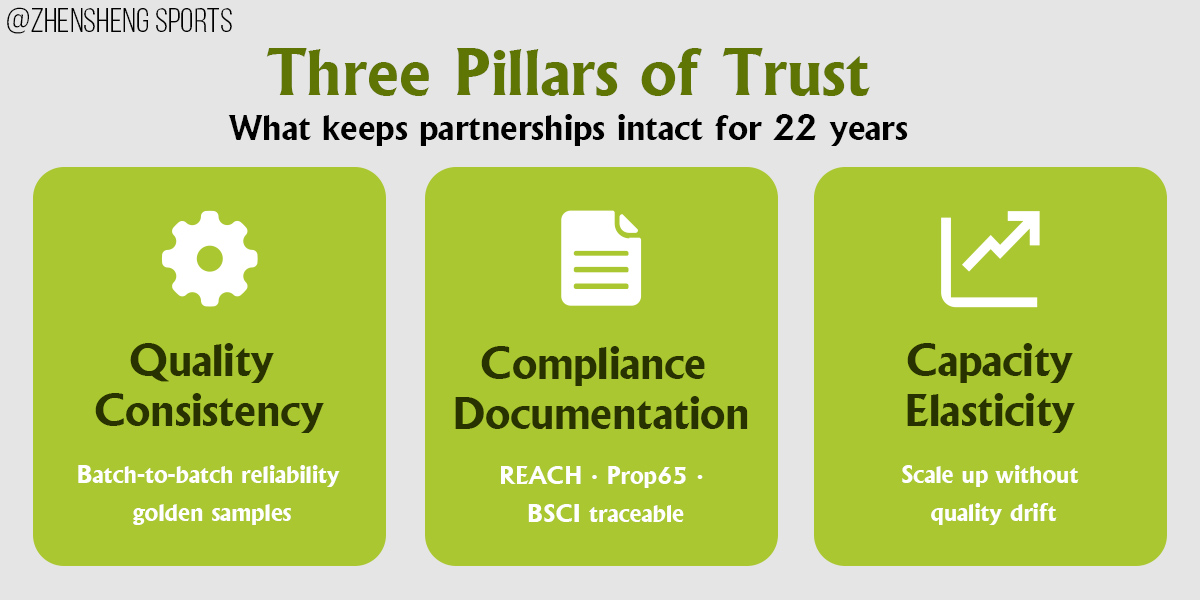
A perfect sample is easy. Delivering that same quality across every production run, year after year, is what separates trusted partners from transactional suppliers. In manufacturing, quality consistency requires controlling variables at every stage, from incoming material verification to in-process monitoring to final inspection.
For a brand, the value of consistency is not just about defect rates. It is about predictability. When a supplier's quality varies, the brand has to compensate — with extra inspections, with customer service, with returns. Predictable quality reduces the brand's cost of doing business. That is why consistency is not just a quality metric; it is a financial one.
How we approach it: Each shipment is held to the same standard as the first. Approved "golden samples" are signed and retained. Incoming materials are checked against approved specifications. In-process inspections monitor dimensions, appearance, and print quality. Final inspections use AQL sampling to verify batch acceptance before shipment.
In today's regulatory environment, compliance is not optional. And for brands, having a supplier who can document compliance at every stage is not a nice-to-have — it is a requirement. Research shows that compliance is shifting from a cost item to a valuation factor, with brands increasingly factoring compliance records into supplier selection.
The challenge for many brands is that smaller or less established suppliers often lack the documentation infrastructure to provide consistent, verifiable compliance records. This creates a compliance gap that brands have to fill themselves — adding cost and risk.
How we approach it: Documentation is built into the process from the start. Material certifications, test reports, and QC records are maintained for every batch. Certifications (REACH, Prop65, BSCI) are validated and renewed as required. Buyers can request and receive compliance documentation on demand. This is not a burden — it is part of the service.
Demand is rarely flat. Brands need suppliers who can handle seasonal spikes, promotional surges, and unexpected order increases without compromising quality or delivery. "Elastic manufacturing" — the ability to rapidly adjust production capacity up or down — is increasingly critical for OEM partnerships.
The companies that survive multiple procurement cycles are the ones that can flex — up for World Cup demand, down for off-seasons, and back up again for holiday campaigns. This requires more than just factory space; it requires a supply chain structure that can adapt without losing quality or operational stability.
How we approach it: Production capacity is not static. We maintain relationships with multiple production partners and design our sourcing and QC processes to scale across different product categories and order volumes, so when orders grow, quality does not shrink.
There is a difference between "we work with global brands" and "we can talk about working with global brands." We choose the first. We do not name-drop specific brand relationships in public-facing content — not because we are not proud of them, but because the trust we have built with those brands includes discretion. The brands that have stayed with us for multiple procurement cycles know who they are. And the buyers we work with today can verify our track record through references and documentation, not through marketing copy.
What we can say is this: we have been manufacturing sports equipment and fitness accessories for over 22 years. We have shipped to more than 50 countries. We have maintained REACH, Prop65, and BSCI certifications because they are table stakes for serious buyers. And we have invested in quality systems, material knowledge, and supply chain integration because that is what it takes to remain a trusted partner over time.
If you are evaluating a supplier for a long-term partnership, here are practical questions to ask:
Consistency: "How do you maintain batch-to-batch consistency across reorders? Can you show me your QC records for the last three shipments?"
Documentation: "Can you provide compliance documentation for your current production batch? What certifications do you maintain, and for how long?"
Elasticity: "What is your capacity for a 50% order increase with three weeks' notice? How have you handled surge demand in the past?"
The brands that survive and thrive are not the ones with the cheapest suppliers. They are the ones with the most reliable suppliers — the ones who have proven they can deliver consistent quality, maintain compliance documentation, and scale with demand over multiple procurement cycles. A supplier who has done this for 22 years has learned what works and, more importantly, what does not. That is what makes a partner worth keeping.
Contact: info@shzhensheng.com
Search Blog
New Products
E-mail: info@shzhensheng.com
:
Tel.: +86 21 5204 8758
Add.: Room 203, Building 1, No. 423 Wuning Road, Putuo district, Shanghai 200063, China
Navigation
Get in touch
seoKeywords: custom size yoga mat custom logo yoga mat custom Rubber Pilates Yoga Mat eco friendly rubber yoga mat custom Pilates Yoga Mat TPE Rubber Professional Yoga Mat rectangle yoga mat tpe comfortable tpe yoga mat comfortable tpe yoga mat Customize nbr yoga mat custom round yoga mat round yoga mats wholesale eco friendly yoga mats wholesale non slip yoga mat wholesale Customize non slip yoga mat wholesale ankle weights wholesale custom round yoga mat round yoga mats wholesale personalized soccer ball size 5 personalized soccer ball size 4 Thermo Bonded Football Machine Stitched Football custom resistance bands wholesale wholesale resistance bands with logo custom printed resistance bands custom logo resistance bands custom size resistance bands custom length resistance bands custom ankle weights ankle weights cost ankle weights cost buy ankle weights custom balance board surf balance board oem yoga mat yoga mat factory yoga mat manufacturer tpe yoga mat manufacturer private label yoga mats