OEM vs. Retail Fitness Accessories: Which Holds Up Better?
If you have any product customization needs or ideas, MOQ 500, contact us.
Jun. 11, 2026
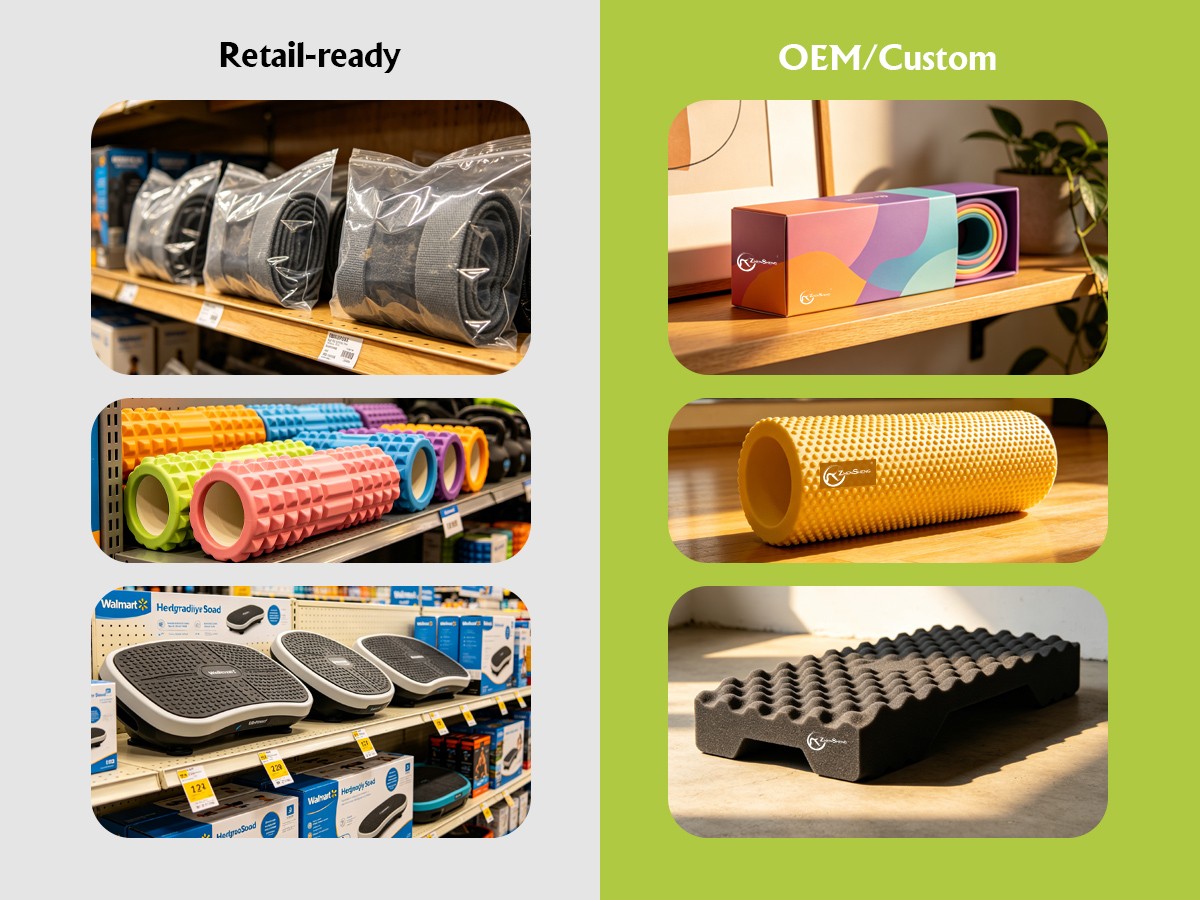
If you need fitness accessories fast and in small quantities, retail-ready products are usually the easiest option. If you care more about brand control, consistent quality across reorders, and long-term scaling, OEM or custom production is often the better investment.
In simple terms:
Choose retail-ready for speed, low minimum order quantities, and quick market testing.
Choose OEM/custom for tighter quality control, stronger consistency across batches, and fully branded products.
| Factor | Retail-ready (off-the-shelf) | OEM / Custom production |
|---|---|---|
| Quality consistency | Moderate; built to general specs | High potential; tolerances are defined and controlled |
| Durability control | Limited to standard factory testing | Custom testing and material selection available |
| Customization & branding | Minimal; basic labels and packaging | Full control over branding, colors, printing, and packaging |
| MOQ | Low; often single units to hundreds | Higher; often thousands, though sometimes negotiable |
| Sampling | Easy to buy and evaluate | Usually requires a sample run |
| Lead time | Short; days to weeks | Longer; typically 6–14+ weeks depending on complexity |
| Best for | Small retailers, startups, test launches | Private-label brands, distributors, growing gyms and studios |
Terms like "high quality" or "durable" are only useful if they can be measured. When comparing suppliers, it helps to look at specific performance checks that connect directly to customer experience and return risk.
For fitness accessories, that usually means evaluating:
Tensile performance for resistance bands
Compression recovery for foam rollers
Density tolerance for foam products
Grip stability for balance boards
Surface finish and color consistency
Packaging accuracy
These details matter because poor consistency shows up quickly in the real world: more returns, worse reviews, and reorders that don't match your original batch.
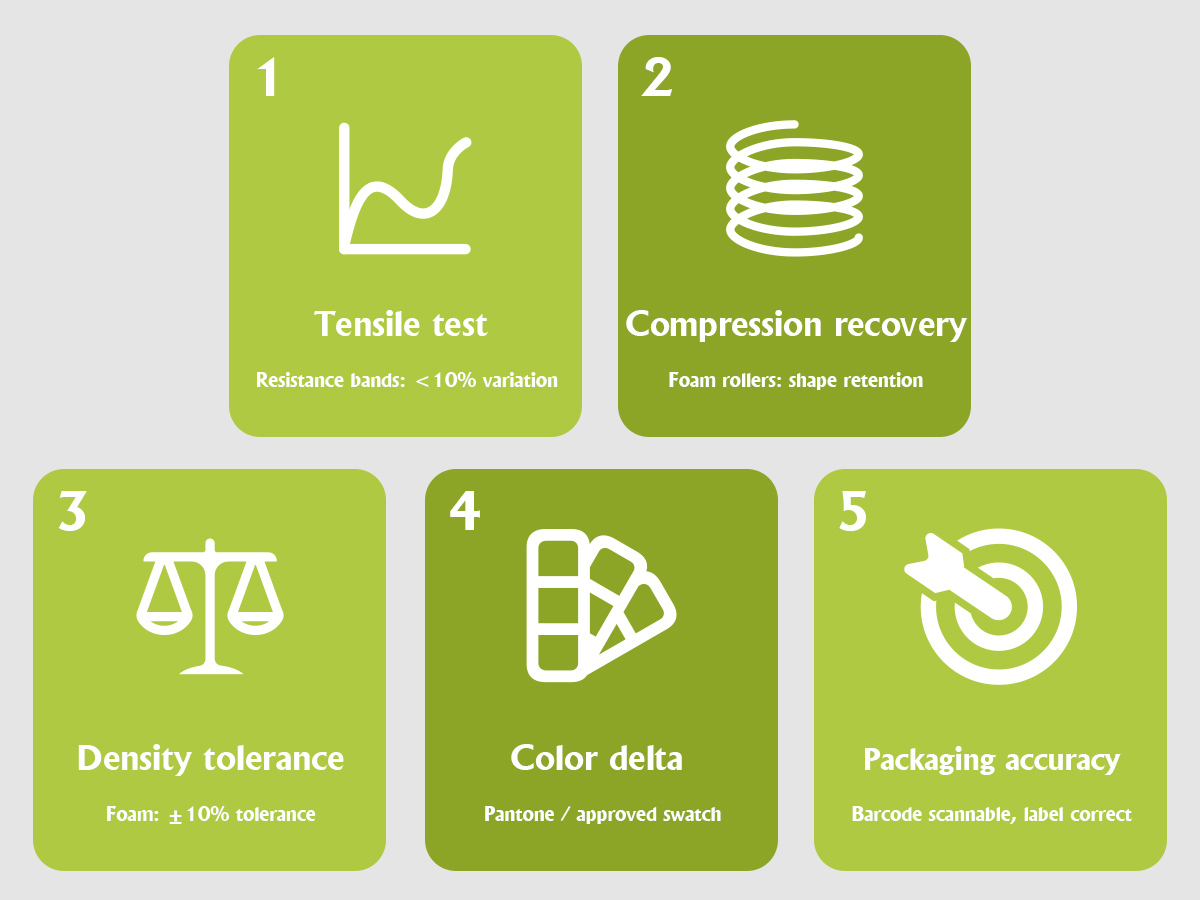
Tensile consistency: Measure peak tension at fixed elongation points. For resistance bands, many buyers aim for less than 10% variation within the same resistance level.
Compression recovery: Measure how well a foam roller rebounds after a fixed load and hold time. Better rebound usually means better shape retention over time.
Density tolerance: Foam density is often listed in kg/m³ or lb/ft³. A variation of +/-10% can noticeably affect feel, support, and durability.
Surface coefficient of friction: This helps identify slip risk for balance boards and similar products, especially on dry and slightly damp surfaces.
Packaging accuracy: Confirm label placement, barcode readability, inserts, and overall presentation.
Not every fitness accessory has the same failure points. A sourcing strategy that works for foam rollers may not be the best choice for resistance bands or balance boards.
Resistance bands depend on elastic consistency, tear resistance, and tension accuracy.
Foam rollers depend on density, rebound, structural integrity, and odor control.
Balance boards depend on deck stability, grip, edge finishing, and load capacity.
That's why it makes more sense to choose a sourcing method by product performance needs, not just by category.
The most important factors here are elasticity retention, tear resistance, thickness tolerance, and consistent tension across sets.
Retail-ready bands are easy to restock and work well for general fitness users. They're a practical choice when speed and low MOQ matter most. The tradeoff is that tension labeling may be less precise, and variation between bands in the same set can sometimes fall in the 10% to 20% range.
OEM/custom bands give you more control over material selection, such as latex or synthetic compounds, wall thickness, and measured tension at defined elongation points. This is especially useful for physical therapy clinics or performance-focused brands that need reliable resistance from batch to batch.
Foam rollers are often judged by density, compression recovery, surface texture, and odor.
Retail-ready foam rollers are widely available and can look consistent on the surface, but long-term compression and off-gassing can vary from supplier to supplier. They're often a solid fit for general retail, starter kits, and beginner-focused audiences.
OEM/custom foam rollers allow you to define foam structure, core construction, and acceptable density tolerances. That makes them a better fit for recovery brands, running-focused lines, or any product line built around repeatable performance claims.
For balance boards, the biggest concerns are deck consistency, anti-slip performance, load capacity, and edge finishing.
Retail-ready options usually meet basic safety expectations, but they can still vary in grip quality, deck flex, and overall finish.
OEM/custom boards let you specify load ratings, testing methods, and anti-slip materials. That level of control is especially important for senior-focused users, rehab use, or any buyer prioritizing consistent safety performance.
Customization offers clear advantages, but every added step introduces another opportunity for inconsistency.
Variables such as:
custom colors
surface printing
adhesive-backed pads
logo applications
packaging inserts
can all affect production consistency. Without strong incoming material checks and in-line quality control, you may see issues like color drift, print misalignment, or adhesive failure.
In other words, customization helps your product stand out, but only if your supplier has the systems to manage it well.
If you're still testing product-market fit, retail-ready inventory is usually the smartest place to start. It lets you move quickly without tying up cash in large production runs.
A good approach is:
Start with retail-ready products if you need single units, small batches, or fast validation.
Move to OEM/custom once demand is proven and you need better branding or tighter consistency.
If you're evaluating OEM production, ask for:
a pre-production sample
a small pilot run
documented test results for key metrics such as tension, density, or load support
Typical timelines look like this:
Samples: 2–6 weeks
Full production: 6–14+ weeks depending on product complexity
Retail-ready products are usually the best choice because they reduce risk, lower inventory commitment, and make replenishment easy.
Many brands begin with retail-ready products to validate demand, then shift to OEM once they have enough volume to support private-label production.
A mixed strategy often works best. Use OEM for member-facing branded items like bands or foam rollers, and use retail-ready stock for quick replacements or lower-priority accessories.
OEM is often the stronger choice, especially when documented tension or density data is important. If buying retail-ready, it's worth choosing only vetted SKUs with reliable test documentation.
OEM is typically the better fit because it supports stronger quality control, batch traceability, and more consistent branded presentation.
Quality inconsistency doesn't stay hidden for long. It shows up in ways customers notice immediately:
resistance bands that feel mismatched
foam rollers that lose shape too quickly
balance boards that feel slippery or unstable
packaging that looks inconsistent or arrives mislabeled
These issues lead to higher return rates, weaker reviews, and lower confidence in future orders. On the other hand, consistent quality helps protect both customer satisfaction and brand presentation online and in stores.
Use retail-ready fitness accessories when speed, low MOQ, and quick testing matter most.
Choose OEM/custom production when repeatability, branding, and long-term reorder confidence are worth the higher lead times and larger minimums.
If you're buying for short-term convenience, retail-ready makes sense. If you're building a brand or scaling a product line, OEM usually holds up better over time.
Search Blog
New Products
E-mail: info@shzhensheng.com
:
Tel.: +86 21 5204 8758
Add.: Room 203, Building 1, No. 423 Wuning Road, Putuo district, Shanghai 200063, China
Navigation
Get in touch
seoKeywords: custom size yoga mat custom logo yoga mat custom Rubber Pilates Yoga Mat eco friendly rubber yoga mat custom Pilates Yoga Mat TPE Rubber Professional Yoga Mat rectangle yoga mat tpe comfortable tpe yoga mat comfortable tpe yoga mat Customize nbr yoga mat custom round yoga mat round yoga mats wholesale eco friendly yoga mats wholesale non slip yoga mat wholesale Customize non slip yoga mat wholesale ankle weights wholesale custom round yoga mat round yoga mats wholesale personalized soccer ball size 5 personalized soccer ball size 4 Thermo Bonded Football Machine Stitched Football custom resistance bands wholesale wholesale resistance bands with logo custom printed resistance bands custom logo resistance bands custom size resistance bands custom length resistance bands custom ankle weights ankle weights cost ankle weights cost buy ankle weights custom balance board surf balance board oem yoga mat yoga mat factory yoga mat manufacturer tpe yoga mat manufacturer private label yoga mats