8 Common Mistakes When Ordering Custom Sports Goods — US Buyer Guide
If you have any product customization needs or ideas, MOQ 500, contact us.
Jun. 10, 2026
Custom fitness and sports products can be profitable, repeatable sellers—but only when product specs, samples, quality control, and packaging are aligned from the start.
This guide is for US importers, private-label brands, retailers, gym suppliers, and procurement managers sourcing items like resistance bands, foam rollers, balance boards, yoga and Pilates products, and rehab tools. The goal is simple: avoid preventable mistakes and get consistent, retail-ready results.
Most sourcing problems start long before production.
A buyer asks for pricing before defining the product in measurable terms. A supplier sends a sample, but the approval process is rushed. Packaging gets finalized late. QC is only considered once the goods are nearly finished.
The result is predictable: inconsistent batches, durability issues, retail packaging failures, barcode problems, and expensive rework.
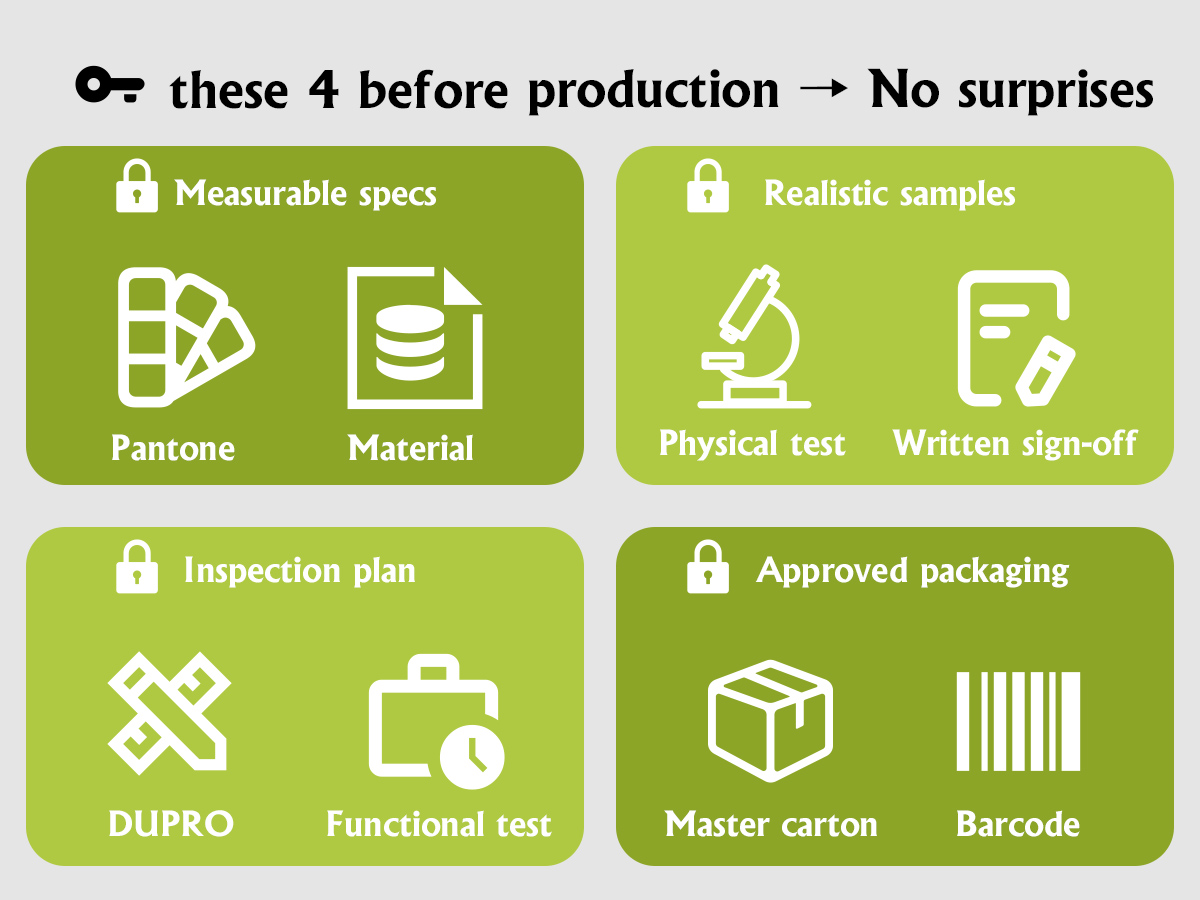
The good news is that most of these risks can be prevented by locking down four things early:
Clear, measurable product specs
Realistic pre-production samples
A practical inspection plan
Approved packaging and labeling requirements
| Mistake | Likely consequence | Quick fix |
|---|---|---|
| Paying attention to price before specs | Wrong materials, poor performance, rework | Create a measurable spec sheet before pricing |
| Leaving key specs vague | Quality disputes, inconsistent branding | Specify tolerances: hardness, thickness, color standard |
| Skipping realistic samples | Bulk order doesn't match expectation | Require 3–5 pre-production samples and test them |
| Ignoring batch consistency | First sample OK, production differs | Run DUPRO/PSI spot checks across cartons |
| Guessing at durability | Returns, recalls, safety incidents | Specify simple durability tests for each product type |
| Treating packaging as an afterthought | Damaged goods, failed retail/fulfillment | Approve retail & master carton proofs and test cartons |
| Ordering wrong MOQ for your channel | Overstock or stockouts | Align MOQ to channel sell-through and replenishment |
| Forgetting labels/import details | Delays at port or retailer rejections | Confirm carton marks, barcodes, and COO marking |
Why it happens:
Many buyers start with a quick quote and define the details later.
What goes wrong:
That low price may be based on lower-grade materials, looser tolerances, or a different construction than you expect. For sports and fitness products, that can mean poor elasticity, weak foam density, cosmetic defects, or inconsistent logo quality.
How to prevent it:
Create a one-page spec sheet before requesting pricing.
Define material type, hardness or durometer, dimensions, tolerances, color standard, finish, and logo placement.
Ask suppliers to quote both the base version and the cost impact of tighter tolerances.
Example:
For resistance bands, don't accept "light," "medium," and "heavy" as the only spec. Require material grade and rated tensile performance.
Why it happens:
Small details seem minor during development, but they drive how the product is actually made.
What goes wrong:
Vague specs lead to disputes over quality, color, feel, print placement, packaging fit, and overall consistency.
How to prevent it:
Define measurable tolerances for length, width, thickness, and weight.
Specify Shore hardness for foam or elastomer parts.
Use Pantone references or approved color swatches.
Include exact logo files, print method, placement coordinates, and expected adhesion or rub resistance.
Require a signed sample approval form tied to the final specs.
Example:
A foam roller spec should include core material, density range, outer texture, and acceptable deflection under load.
Why it happens:
Photo approvals are faster and cheaper.
What goes wrong:
A product may look fine in photos but feel wrong, perform poorly, or fail quickly in actual use.
How to prevent it:
Request 3–5 samples before mass production.
Review an early prototype, then inspect pre-production samples made with actual production methods.
Test what matters: elasticity, compression recovery, print adhesion, hardware security, texture, and stability.
Document approval in writing and connect the PO to the approved sample with photos or serial references.
Example:
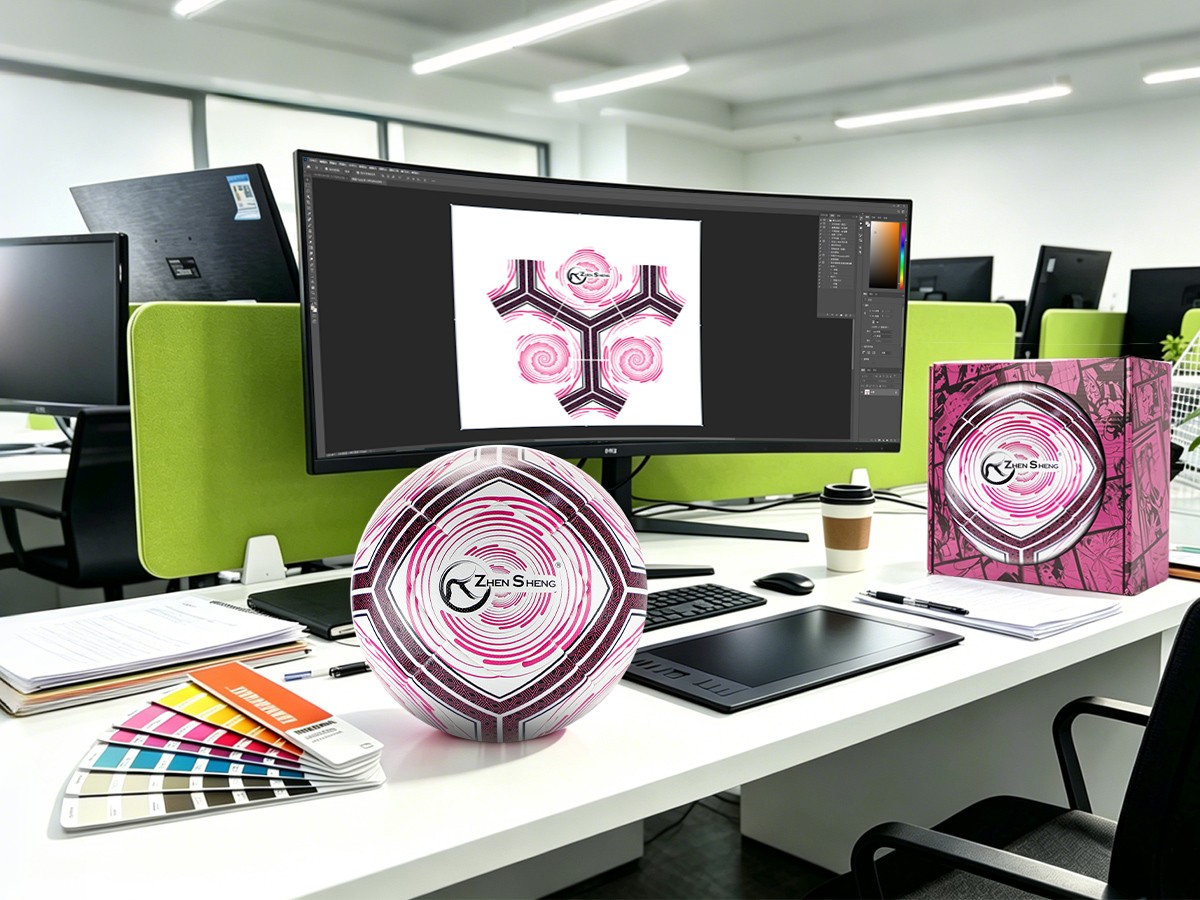
A soccer ball may look acceptable in a photo but reveal wobble instability or loose hardware in a hands-on test.
Why it happens:
One good sample creates a false sense of security.
What goes wrong:
Production can vary by machine, operator, material lot, or shift. That can create color drift, hardness changes, print misalignment, or inconsistent packaging across cartons.
How to prevent it:
Set acceptable ranges for dimensions, color, and hardness.
Include inspection frequency in your agreement.
Use During Production Inspection (DUPRO) and Pre-Shipment Inspection (PSI) to check samples from multiple cartons and runs.
Ask for lot traceability and corrective action records if defects are found.
A sample is not proof of consistent production. It is only the starting point.
Why it happens:
Buyers often rely on general promises like "high quality" or "gym grade" instead of defining basic performance requirements.
What goes wrong:
Bands snap, foam collapses, pivots fail, and print rubs off. In fitness products, durability is not just a quality issue—it can become a safety issue.
How to prevent it:
Define simple durability tests by product category.
For bands and elastomer products, require tensile or cyclic-stretch testing and ask which method is used. ASTM D412 is a common reference for elastomers.
For foam rollers, specify density and compression-recovery requirements.
For balance boards, include pivot durability, fastener torque checks, and stability testing.
List unacceptable failure modes clearly: snapping, seam separation, core collapse, rapid elasticity loss, or print failure.
If the product will be stretched, compressed, rolled, stood on, or repeatedly loaded, durability should be documented—not assumed.
Why it happens:
Packaging is often left until the product itself is approved.
What goes wrong:
Units arrive damaged, barcodes don't scan, master cartons fail in transit, or retail packaging doesn't meet shelf or fulfillment requirements.
How to prevent it:
Approve both unit packaging and master carton specs before production begins.
Confirm pack count, protective inserts, carton strength, and pallet pattern.
Verify barcode type, size, and placement.
If the product will ship through ecommerce channels, consider transit testing or an ISTA-style packaging review.
Good packaging protects more than the product. It protects margin, sell-through, and receiving efficiency.
Why it happens:
Factory MOQs are based on production efficiency, not your sales reality.
What goes wrong:
You overbuy slow SKUs, tie up cash, or run out of fast movers. If you launch too many variants at high MOQs, the risk multiplies.
How to prevent it:
Start with your actual channel demand.
Ecommerce sellers may need lower MOQs with faster replenishment.
Retail programs may require palletized quantities and fixed pack counts.
Consider a pilot run, mixed production with existing runs, or a slightly higher unit cost for a smaller validation order.
Compare landed cost across several MOQ levels before committing.
A "good" MOQ is not the cheapest one. It is the one that fits your sales velocity and replenishment plan.
Why it happens:
These details are often treated as admin work and pushed to the end.
What goes wrong:
Shipments get delayed, retailer receiving teams reject cartons, or warehouse systems can't process the goods correctly.
How to prevent it:
Confirm carton markings in advance: PO number, country of origin, pack count, gross weight, and net weight.
Verify barcode and logistics label placement.
Check whether your retailer or 3PL requires SSCC labels or other specific pallet labels.
Confirm country-of-origin marking requirements with your customs broker and make sure packing lists and invoices match.
Import details are easy to overlook—and expensive to fix late.
A solid inspection plan should include the basics below:
Dimensions: Measure length, width, height, and thickness on a relevant sample size.
Material verification: Review certificates and check durometer or density where applicable.
Color consistency: Compare against Pantone or approved standards.
Logo and print quality: Check alignment, clarity, and adhesion.
Odor and finish: Look for strong chemical smells, surface defects, and inconsistent texture.
Functional testing: Stretch and recovery for bands, compression recovery for foam rollers, wobble and stability checks for balance boards, hardware torque checks where needed.
Packaging checks: Confirm SKU accuracy, barcode scannability, polybag requirements, carton strength, and palletization.
If you use a third-party inspection firm, define sample size, acceptance criteria, and the action required if a batch fails—reject, quarantine, or rework.
Use a simple process that can be repeated across products and suppliers:
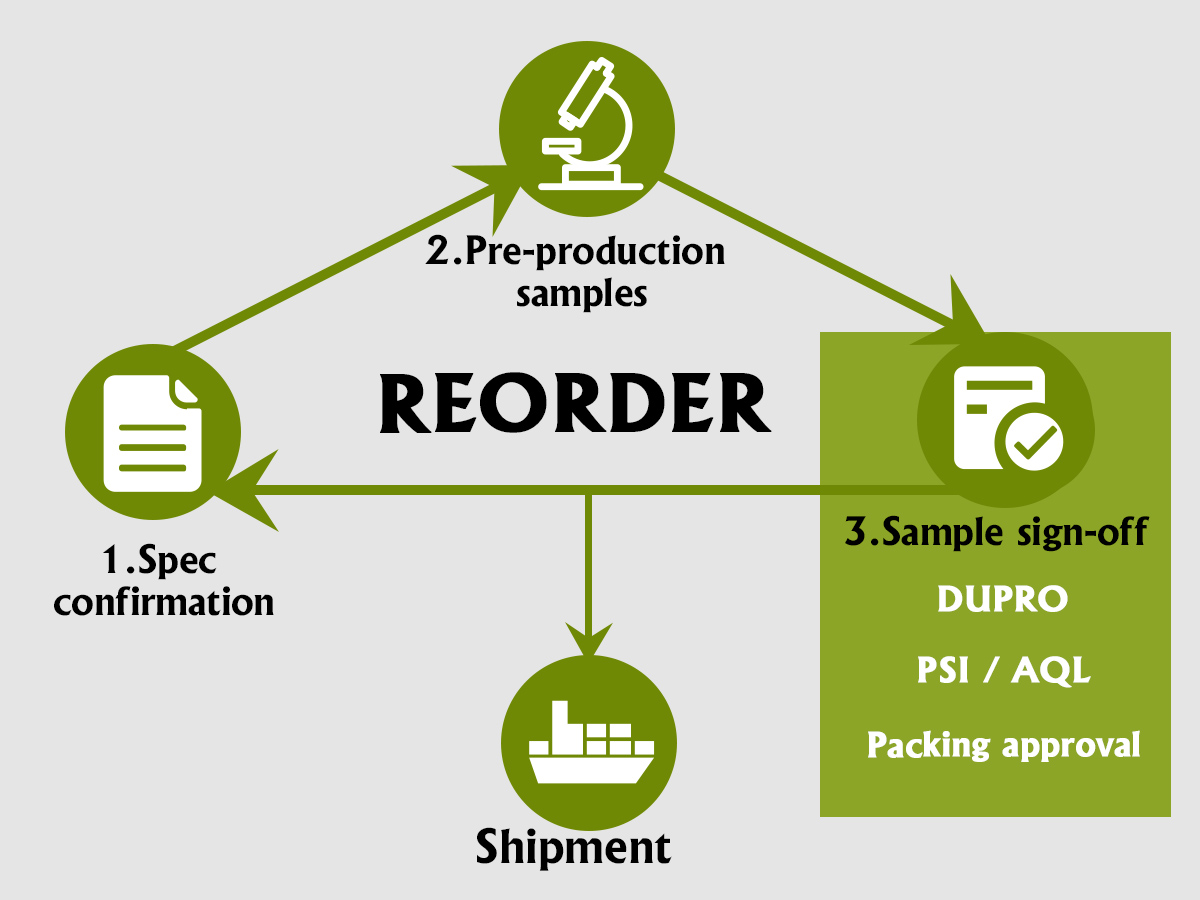
Send the factory a complete spec sheet and tech pack.
Review a prototype sample for material, shape, and basic fit.
Request 2–4 pre-production samples made on the real production line.
Test each sample for dimensions, appearance, feel, function, and packaging fit.
Approve in writing or issue a correction list.
For more complex products, request a small pilot run.
Schedule DUPRO or PSI checks before the full order ships.
This process takes more discipline up front, but it dramatically reduces surprises later.
Different product types fail in different ways. Your QC plan should reflect that.
Resistance bands: Common failures include snapping, anchor or handle separation, and loss of elasticity. Require stretch-cycle testing and a documented tensile method.
Foam rollers: Watch for core collapse, cracking, and permanent deformation. Require density and compression-recovery checks.
Balance boards: Common risks include pivot failure, loose hardware, and inconsistent wobble. Add torque checks and functional stability testing.
Yoga and Pilates mats: Look for abrasion, delamination, thickness loss, and poor slip performance.
Rehab and massage tools: Check for finish wear, adhesive failure, odor issues, and strap or accessory weakness.
The test does not have to be overly complicated. It just has to be defined, repeatable, and relevant to how the product is actually used.
If you sell through retail, Amazon, or other fulfillment networks, packaging matters just as much as the product.
Unit packaging: Approve artwork, barcode location, and protective inserts.
Master cartons: Lock down pack count, carton marks, pallet patterns, and strength requirements.
Fulfillment readiness: Make sure each sellable unit has a visible, scannable barcode and follows marketplace labeling rules.
Transit protection: For higher-risk SKUs, request packaging performance data or run drop and compression tests.
A product that arrives damaged or unscannable is still a failed order—even if the product itself was made correctly.
How many samples should I review before approving production?
Aim for 3–5 total samples, including at least one made on the planned production line.
What should I test first when a sample arrives?
Start with critical dimensions, material feel, logo quality, and one short functional test tied to real use.
When should packaging be approved?
Before mass production begins. That allows barcode placement, carton sizing, and protective packaging to be verified early.
The strongest custom sports goods programs follow a simple pattern:
Define measurable specs
Approve realistic pre-production samples
Lock packaging and barcode requirements early
Inspect during production and before shipment
Match MOQ to your actual sales channel
Document every approval clearly
When the approved sample, packaging standard, and inspection criteria are tied directly to the purchase order, you reduce ambiguity and improve consistency from one order to the next.
That is how you turn custom sourcing from a gamble into a repeatable system.
Search Blog
New Products
E-mail: info@shzhensheng.com
:
Tel.: +86 21 5204 8758
Add.: Room 203, Building 1, No. 423 Wuning Road, Putuo district, Shanghai 200063, China
Navigation
Get in touch
seoKeywords: custom size yoga mat custom logo yoga mat custom Rubber Pilates Yoga Mat eco friendly rubber yoga mat custom Pilates Yoga Mat TPE Rubber Professional Yoga Mat rectangle yoga mat tpe comfortable tpe yoga mat comfortable tpe yoga mat Customize nbr yoga mat custom round yoga mat round yoga mats wholesale eco friendly yoga mats wholesale non slip yoga mat wholesale Customize non slip yoga mat wholesale ankle weights wholesale custom round yoga mat round yoga mats wholesale personalized soccer ball size 5 personalized soccer ball size 4 Thermo Bonded Football Machine Stitched Football custom resistance bands wholesale wholesale resistance bands with logo custom printed resistance bands custom logo resistance bands custom size resistance bands custom length resistance bands custom ankle weights ankle weights cost ankle weights cost buy ankle weights custom balance board surf balance board oem yoga mat yoga mat factory yoga mat manufacturer tpe yoga mat manufacturer private label yoga mats