Pickleball Paddle Materials Guide: From Surface to Core
If you have any product customization needs or ideas, MOQ 500, contact us.
Jun. 22, 2026
Pickleball paddles have a three-layer construction, and materials differ between the surface and core layers. Based on the materials used, paddle performance can vary significantly-power, control, spin, feel, and durability all depend on material choices.
Understanding both the surface and core materials is essential for OEM buyers, private-label brands, and distributors looking to source the right paddle for the right market segment. This guide breaks down paddle construction into five key dimensions: surface materials, core materials, construction processes, product generations, and market positioning.
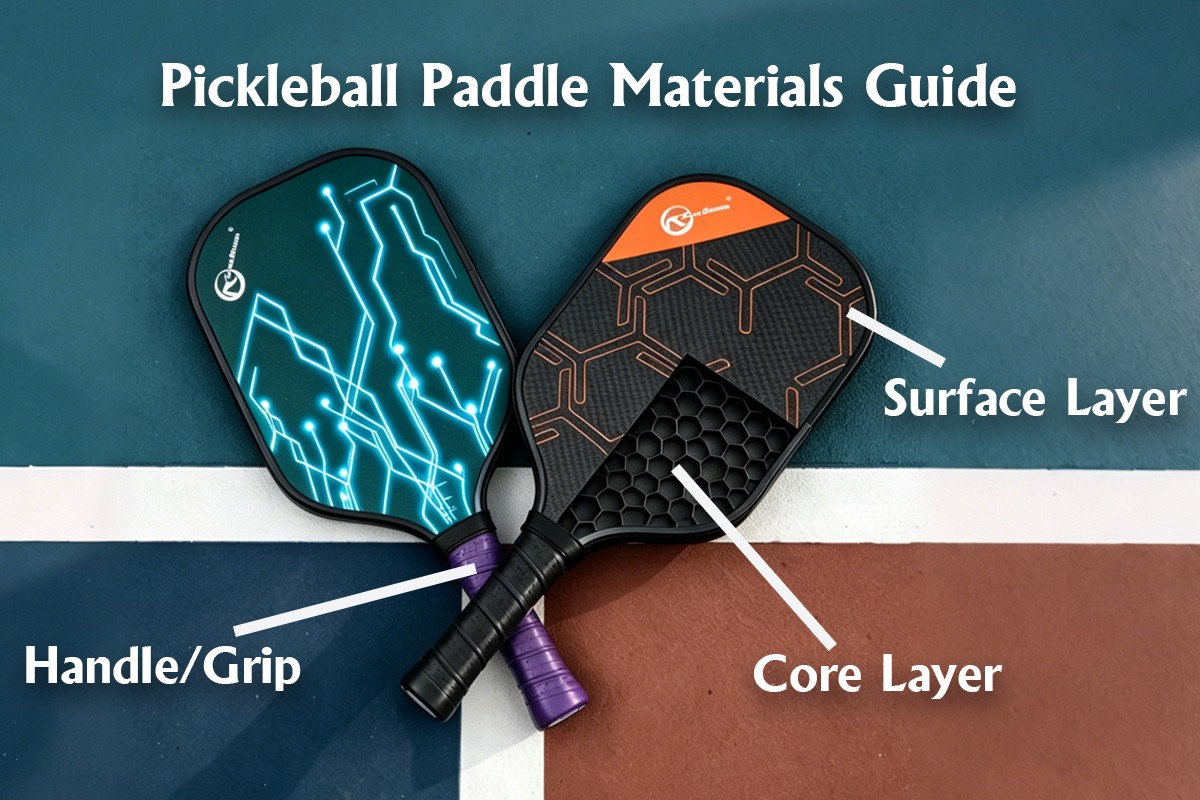
A pickleball paddle is not made from a single material. It has a distinct three-layer construction:
Paddle core - The base structure that gives the paddle its thickness. The core material affects the paddle's weight, stiffness, power, and vibration dampening.
Paddle face (surface) - The outer material on both sides of the paddle that actually hits the ball. The surface influences the paddle's control, spin, and surface durability.
Handle and edge - The grip material and protective edge frame that affect feel and durability.
Think of it like a sandwich: the core is the filling, and the face is the bread. You should choose the best combination of both materials-not just focus on one.
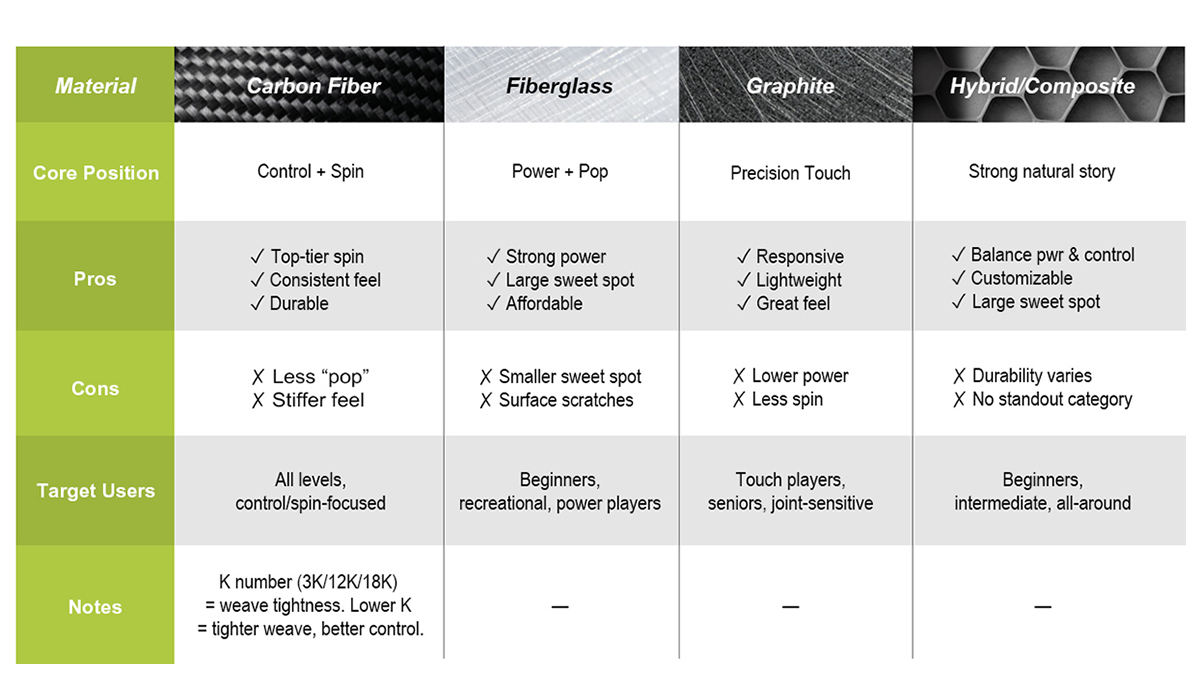
The face material directly impacts how the paddle feels, how much spin you can generate, and how durable the paddle will be.
| Material | Key Characteristics | Pros | Cons | Best For |
|---|---|---|---|---|
| Carbon Fiber | Stiff, lightweight, woven ribbons, excellent energy absorption | Top-tier control and spin, consistent performance, durable | Less 'pop' (power), stiffer feel, requires technique | All levels, especially control-focused and spin-dependent players |
| Fiberglass | Flexible, woven glass fibers in resin, thicker and more forgiving | Power, noticeable 'pop', good spin, large sweet spot, affordable | Smaller sweet spot, less control, surface can scratch | Beginners, recreational, power-focused players |
| Graphite | Thin, rigid, tightly packed carbon layers (millimeters thick) | Precise shots, highly responsive, lightweight, great handling | Less raw power, less bounce, less spin (depends on texture) | Touch/control players, seniors, joint-pain sufferers |
| Hybrid/Composite | Blend of materials (e.g., fiberglass + carbon fiber + Kevlar) | Balances power and control, large sweet spot, customizable | Durability varies depending on blend, 'no standout' performance | Beginners, intermediate, all-around players |
Pro Tip: The lower the K number in carbon fiber (3K, 12K, 18K), the tighter the weave and generally the better the performance. Higher K means stiffer, more powerful, and harder-hitting surfaces, but may sacrifice some touch.
The core determines the paddle's weight, stiffness, power, and vibration dampening. Over 85-90% of paddles today use polymer honeycomb cores.
| Core Material | Structure | Characteristics | Pros | Cons | Best For |
|---|---|---|---|---|---|
| Polymer Honeycomb (Polypropylene/PP) | Honeycomb cells, small or large | Balanced, durable, lightweight, quiet | Balances control and power, large sweet spot, quiet, durable, fatigue-resistant | Less raw power, requires more swing for speed | All skill levels (beginners to pros) - 90% of today's paddles |
| Nomex Honeycomb | Aramid fiber honeycomb coated in resin | Hard, dense, rigid, powerful | Power, very hard shots, stays rigid over time | Loss of control, unforgiving on soft dinks, noisy, more vibration | Advanced power players |
| Aluminum | Aluminum honeycomb | Lightweight, sturdy | Lightweight, sturdy, good control | Less common, may not absorb vibration as well | Intermediate to advanced (less common) |
| Foam Core (4th Gen) | Full foam (no honeycomb) | Even vibration absorption, consistent response | Superior dampening, consistent response, longer life | New tech, still being tested | - |
Core Density Note: Smaller honeycomb cells = firmer, more powerful, more durable paddle. Larger cells = softer, more control, but less durable.
How a paddle is made is just as important as what it's made of. Two main processes dominate: cold press and hot press.
| Process | Method | Pros | Cons | Typical Use |
|---|---|---|---|---|
| Cold Press (Cold Molding) | Layers bonded under high pressure at room temperature | Faster production, lower cost, affordable paddles | Less uniform structure, lower durability, may de-laminate over time | Entry-level, recreational, budget paddles |
| Hot Press / Thermoforming | Heat + pressure to fuse materials at high temperature | Superior strength, uniform structure, consistent performance, longer life | More expensive, longer production time, higher unit cost | Professional, high-performance, tournament paddles |
Thermoforming Advantage: Hot-pressed paddles have more consistent energy transfer, better durability, and a larger sweet spot-making them the standard for high-performance paddles today.
Pickleball paddle technology has evolved through three distinct generations, each with different constructions and performance characteristics.
| Feature | Gen 1 (First Gen) | Gen 2 (Second Gen) | Gen 3 (Third Gen) |
|---|---|---|---|
| Construction | Basic glued/ cold-pressed layers | Thermoformed (hot-pressed) with foam edge injection | Multi-layer foam injection, enhanced textured surfaces |
| Power | Low - control-focused | Medium to high - good elasticity | High - explosive power, great spin |
| Control | High - excellent for precise shots | Medium - balanced power and control | High - combines power with precision |
| Spin | Low | Medium | Very high - surface texture dramatically improves spin |
| Sweet Spot | Small to medium | Large | Large - optimized design |
| Durability | Good | Excellent | High - but some cores may collapse over time |
| Typical Price | Low | Medium to high | High |
| Best For | Beginners, casual players | Intermediate to advanced | Advanced, tournament players |
Important Note: Some Gen 3 paddles have been banned due to excessive power and spin that exceed competition standards. Always verify USAPA (USA Pickleball) approval status before sourcing for tournaments.
Weight directly affects swing speed, control, and power. Choosing the right weight prevents arm fatigue and injury.
| Weight Class | Ounces (oz) | Grams (g) | Characteristics | Best For |
|---|---|---|---|---|
| Light | 7.2-7.6 oz | 204-215 g | Fast swing speed, quick reaction, less power | Beginners, juniors, seniors, defensive players, former table tennis/badminton players |
| Midweight | 7.6-8.2 oz | 216-232 g | Balance of power and control, most popular | Most players, 'safest' starting point, all-around play |
| Heavy | 8.3 oz+ | 233 g+ | Maximum power, strong stability, higher arm strain | Power players, former tennis players, advanced players |
When sourcing for private-label or wholesale, align your paddle specifications with the target market:
Beginners / Recreational: Fiberglass or composite face + polymer core + cold-pressed construction - 16mm thickness, midweight (7.6-8.2 oz), large sweet spot
Intermediate / Club Players: Carbon fiber or hybrid face + polymer honeycomb core + thermoformed construction - 14-16mm, balanced weight, good spin
Advanced / Tournament: Gen 2 or Gen 3 construction + premium carbon fiber face + polymer or foam core - high spin texture, thermoformed, USAPA-approved
Budget / Bulk Training: Fiberglass face + polymer core + cold-pressed - durable, low cost, consistent basic performance
The market continues to evolve with new technologies like Gen 3 paddles with enhanced surface texture and spin potential. For OEM buyers, understanding these construction details is the first step to delivering the right paddle for the right player segment.
Sourcing a pickleball paddle is about finding the right combination of materials and construction for the target player:
Surface: Carbon fiber for control/spin, fiberglass for power, graphite for touch
Core: Polymer for most players, Nomex for power players, foam for emerging premium segment
Construction: Thermoforming for performance, cold-press for budget
Generation: Gen 1 for beginners, Gen 2 for intermediate, Gen 3 for advanced
Weight: Light for quick hands, midweight for most players, heavy for power
New technologies like Gen 3 foam-injected paddles and 4th-gen all-foam cores represent the next wave of innovation. For OEM buyers, understanding these construction details is the first step to delivering the right paddle for the right market segment.
Search Blog
New Products
E-mail: info@shzhensheng.com
:
Tel.: +86 21 5204 8758
Add.: Room 203, Building 1, No. 423 Wuning Road, Putuo district, Shanghai 200063, China
Navigation
Get in touch
seoKeywords: custom size yoga mat custom logo yoga mat custom Rubber Pilates Yoga Mat eco friendly rubber yoga mat custom Pilates Yoga Mat TPE Rubber Professional Yoga Mat rectangle yoga mat tpe comfortable tpe yoga mat comfortable tpe yoga mat Customize nbr yoga mat custom round yoga mat round yoga mats wholesale eco friendly yoga mats wholesale non slip yoga mat wholesale Customize non slip yoga mat wholesale ankle weights wholesale custom round yoga mat round yoga mats wholesale personalized soccer ball size 5 personalized soccer ball size 4 Thermo Bonded Football Machine Stitched Football custom resistance bands wholesale wholesale resistance bands with logo custom printed resistance bands custom logo resistance bands custom size resistance bands custom length resistance bands custom ankle weights ankle weights cost ankle weights cost buy ankle weights custom balance board surf balance board oem yoga mat yoga mat factory yoga mat manufacturer tpe yoga mat manufacturer private label yoga mats