Pickleball Paddle Sourcing Guide: Why This Category Is Booming — and What Buyers Should Know
If you have any product customization needs or ideas, MOQ 500, contact us.
Aug. 14, 2026
Pickleball has been the fastest-growing sport in the United States for five consecutive years, with 24.3 million Americans playing in 2025. The global pickleball equipment market was valued at approximately $1.9 billion in 2025 and is projected to reach $4.4 billion by 2033, representing a CAGR of 11.3%.
The sport has expanded to 78 member countries in the International Pickleball Federation, and major brands including Nike, Wilson, and Skechers have entered the space. For B2B buyers, the question is no longer whether to source pickleball equipment — it is how to do it strategically.
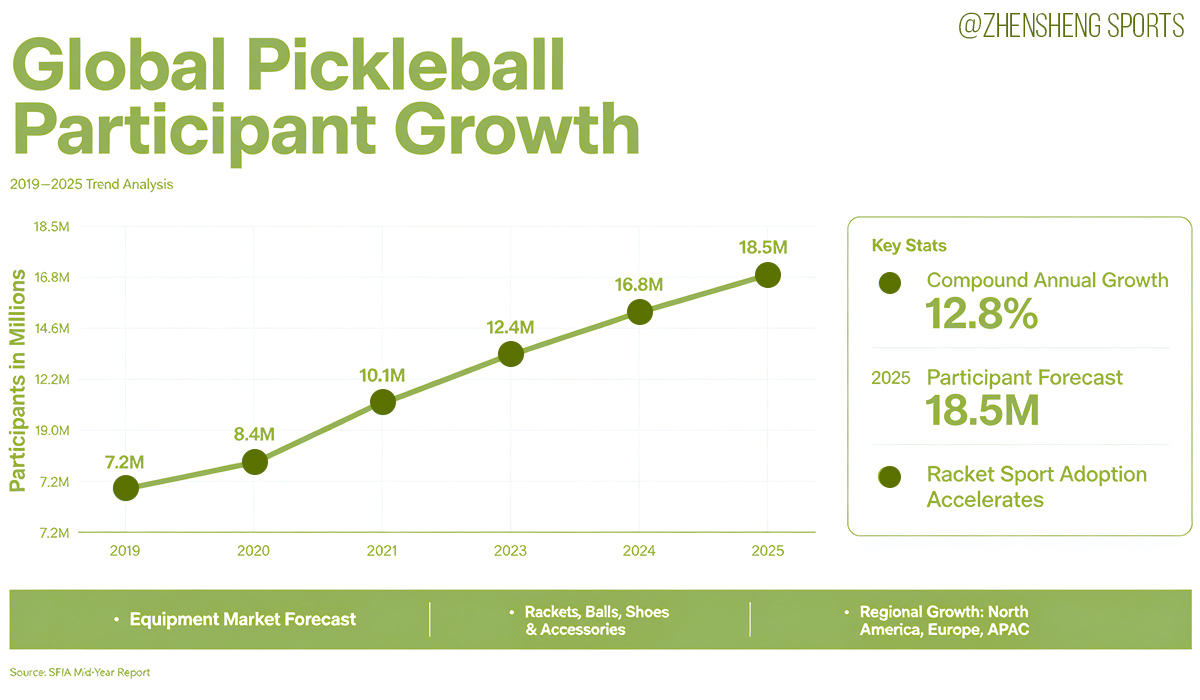
The growth of pickleball is not a pandemic-era flash in the pan. The data shows a structural shift in how Americans engage with racquet sports.
| Metric | Value | Notes |
|---|---|---|
| U.S. Participation (2025) | 24.3 million | 5-year consistent growth |
| Global Market 2025 | ~$1.9 billion | Baseline |
| Global Market 2033 | ~$4.4 billion | CAGR 11.3% |
| IFP Member Countries | 78 | Rapid international expansion |
Market signal: The paddle certification boom peaked in 2024 with 1,293 new paddles. 2026 is on pace for ~518 — a 60% drop from peak. This is not a decline in demand, but a market maturing toward quality over quantity.
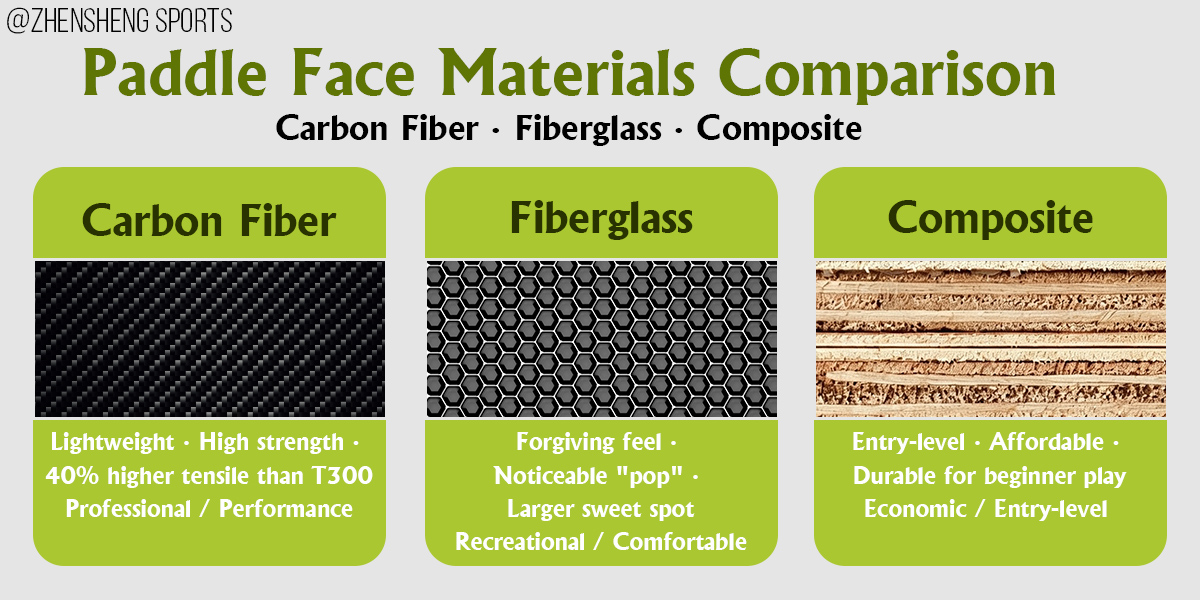
Understanding paddle construction is essential for procurement decisions. Performance is determined by the combination of surface and core materials.
| Surface Material | Key Characteristics | Best Fit |
|---|---|---|
| Carbon Fiber (T700) | 40% higher tensile strength than T300. Raw carbon offers maximum spin and control. Professional grade. | Professional / Performance |
| Fiberglass | More forgiving, lower price point. Noticeable "pop" and larger sweet spot. | Recreational / Comfortable |
| Composite / Graphite | Balanced performance between power and control. Mid-tier price point. | Economic / Entry-level |
| Core Material | Key Characteristics | Best Fit |
|---|---|---|
| Polymer Honeycomb (PP) | Industry standard. Balanced power and control, large sweet spot, quiet, durable. 16mm for control, 14mm for power. | All skill levels (90% of market) |
| EVA Foam | Superior vibration dampening and consistent response. Premium segment. | Advanced / Premium |
| Nomex | Aramid fiber. Hard, dense, powerful. Noisier on contact. | Power players (less common) |
Buyers have two primary paths for sourcing paddles. Each serves different business stages and objectives.
| Factor | Wholesale (White Label) | OEM / Private Label |
|---|---|---|
| MOQ | 20–50 units | 100–500 units typical; 500+ for full custom |
| Cost per unit (FOB) | $15–25 | $18–35 (premium materials) |
| Customization | Logo only | Full: face, core, grip, edge, packaging |
| Lead Time | 2–4 weeks | 6–10 weeks production + shipping |
| Retail Markup Potential | 30–50% | 200–500% |
| Brand Equity | Low — identical to competitors | High — unique product, proprietary spec |
| Best For | Testing demand, quick entry, clubs | Building a brand, premium pricing, scale |
Decision rule: If you are moving fewer than 500 paddles a year, wholesale is the safe play. Once you cross the 500–1,000 unit threshold, OEM starts making serious financial sense — with margins that justify the additional investment.
Different channels have different product requirements. Aligning paddle specification with the end user is critical for repeat orders.
| Channel | Recommended Spec | Key Requirements | Typical Order Size |
|---|---|---|---|
| Retail / E-commerce | Carbon fiber or hybrid face, polymer core, 16mm thickness | Retail-ready packaging, USAPA-approved, brand presentation | 500–5,000 units |
| Clubs / Gyms | Fiberglass or composite face, polymer core, midweight (7.6–8.2 oz) | Durable edge guard, bulk packaging, consistent feel across paddles | 50–200 units per order, repeat |
| Schools / Youth Programs | Composite or lightweight graphite, lighter weight (7.0–7.3 oz) | Safety, durability, lower cost, bulk shipping | 100–500 units |
| Tournaments / Events | Branded semi-custom, mid-tier construction | Custom logo, event packaging, strict deadline delivery | 500–1,000 units (seasonal) |
Paddle quality directly affects customer satisfaction and return rates. Here are the non-negotiable QC checkpoints.
Surface texture (COF): Spin consistency depends on surface roughness. Raw carbon fiber should have measurable grit. Factory self-inspection is insufficient — use third-party (SGS, Intertek, BV).
Weight tolerance: USAPA requires ±2g per paddle. Batch consistency across units matters more than individual accuracy.
Edge guard adhesion: The most common failure point. Test peel strength and resistance to impact. For cold climates, specify polyurethane-based adhesive.
Core integrity: Check for delamination after impact testing. Polymer honeycomb cores should retain shape under repeated use.
USAPA certification: If targeting tournament players, confirm certification is completed ($500–800 per model, 4-6 weeks).
ZhenSheng offers OEM/ODM pickleball paddle manufacturing with flexible MOQs and full customization support.
Surface options: T700 raw carbon fiber, fiberglass, graphite composite
Core options: Polymer honeycomb (standard), EVA foam, Nomex
Customization: Logo printing, grip size, packaging design, edge guard color
Quality assurance: REACH, Prop65, BSCI certified; third-party inspections supported
MOQ: Flexible — starting from 100 units for semi-custom, 500+ for full custom
Lead time: Samples 7-15 days; bulk production 30-50 days
The pickleball paddle market is maturing. The gold rush era of rapid certifications is behind us, but the underlying demand remains strong. Winners in this market will be brands that focus on product quality, material integrity, and reliable supply chains — not the cheapest paddle.
For B2B buyers, the key decisions are simple: understand your channel, match your specs to the user, and choose a manufacturing partner who can deliver consistency across batches. The brands that get this right will own the category as it moves from "fastest-growing" to "mainstream."
Contact: info@shzhensheng.com
Search Blog
New Products
E-mail: info@shzhensheng.com
:
Tel.: +86 21 5204 8758
Add.: Room 203, Building 1, No. 423 Wuning Road, Putuo district, Shanghai 200063, China
Navigation
Get in touch
seoKeywords: custom size yoga mat custom logo yoga mat custom Rubber Pilates Yoga Mat eco friendly rubber yoga mat custom Pilates Yoga Mat TPE Rubber Professional Yoga Mat rectangle yoga mat tpe comfortable tpe yoga mat comfortable tpe yoga mat Customize nbr yoga mat custom round yoga mat round yoga mats wholesale eco friendly yoga mats wholesale non slip yoga mat wholesale Customize non slip yoga mat wholesale ankle weights wholesale custom round yoga mat round yoga mats wholesale personalized soccer ball size 5 personalized soccer ball size 4 Thermo Bonded Football Machine Stitched Football custom resistance bands wholesale wholesale resistance bands with logo custom printed resistance bands custom logo resistance bands custom size resistance bands custom length resistance bands custom ankle weights ankle weights cost ankle weights cost buy ankle weights custom balance board surf balance board oem yoga mat yoga mat factory yoga mat manufacturer tpe yoga mat manufacturer private label yoga mats