World Cup Football Construction: Manufacturing & Sourcing (Part 2)
If you have any product customization needs or ideas, MOQ 500, contact us.
Jun. 22, 2026
In Part 1, we covered leather materials, panel shapes, and bladder types. This part covers manufacturing processes, size standards, and OEM sourcing considerations for the 2026 World Cup ball and beyond.
FIFA defines strict standards for official match balls. Understanding these helps you choose the right ball for the right age group and competition level.
| Size | Circumference | Weight | Recommended Age | Use Case |
|---|---|---|---|---|
| Size 5 | 68-70 cm | 410-450 g | 12 years + | 11-a-side official matches |
| Size 4 | 63-66 cm | 350-390 g | 8-12 years | Futsal, youth 5-a-side |
| Size 3 | 58-61 cm | 300-320 g | 6-8 years | Junior training |
How the ball is assembled determines its durability, water resistance, and overall performance.
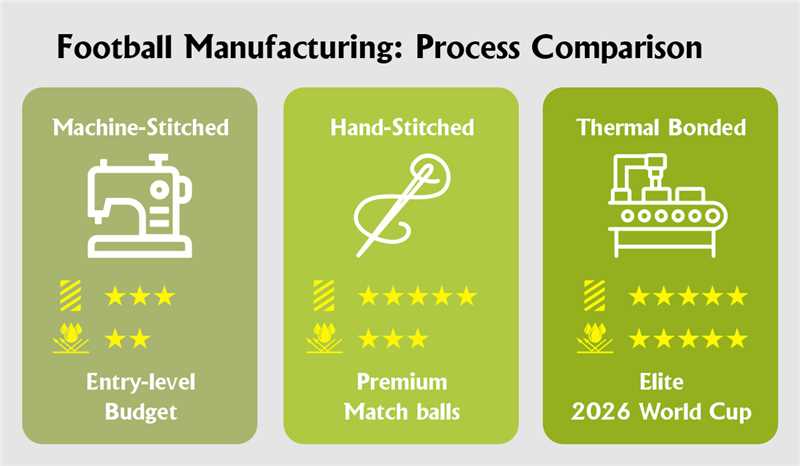
| Process | Construction | Durability | Water Resistance | Grade |
|---|---|---|---|---|
| Machine-stitched | Sewn by machine, fine thread | Moderate | Low — water enters stitch holes | Entry-level, budget |
| Hand-stitched | Hand-stitched, thick thread, reinforced layers | Very durable | Moderate | Premium, match balls |
| Thermal Bonded | Heat-fused, no stitches | Excellent — no seam weakness | Excellent — waterproof | Elite, 2026 World Cup |
2026 World Cup Manufacturing: The "Triple Wave" ball is produced in China using thermal bonding and uses a butyl bladder with an embedded chip (CONNECTED BALL technology) that records 500 touches per second for VAR decisions.
When sourcing footballs for private-label or wholesale, align your product spec with the target market:
Match balls (premium): PU cover + latex bladder + hand-stitched or thermal bonded — 32 or 4-panel
Training balls (mid-tier): PU or TPU cover + butyl bladder + machine-stitched — 32-panel
Recreational / budget: PVC cover + butyl bladder + machine-stitched — 32-panel
Futsal / indoor: Size 4, often with extra foam layer for reduced bounce
The 2026 World Cup has elevated expectations: buyers now look for sustainable materials (bio-based polyester, recycled fabrics, eco-friendly inks) and performance certification.
Sourcing a football is not just about choosing between Size 4 and Size 5. The key decisions are:
Leather: PU for match feel, PVC for budget durability, TPU for soft touch
Panels: Fewer panels = smoother flight and better aerodynamics
Bladder: Latex for match performance, butyl for convenience and lower cost
Construction: Thermal bonding for premium, hand-stitched for traditional durability, machine-stitched for budget
The 2026 World Cup has made 4-panel thermal-bonded balls with chip-enabled bladders the new benchmark for elite performance. For OEM buyers, understanding these construction details is the first step to delivering the right ball for the right market.
Search Blog
New Products
E-mail: info@shzhensheng.com
:
Tel.: +86 21 5204 8758
Add.: Room 203, Building 1, No. 423 Wuning Road, Putuo district, Shanghai 200063, China
Navigation
Get in touch
seoKeywords: custom size yoga mat custom logo yoga mat custom Rubber Pilates Yoga Mat eco friendly rubber yoga mat custom Pilates Yoga Mat TPE Rubber Professional Yoga Mat rectangle yoga mat tpe comfortable tpe yoga mat comfortable tpe yoga mat Customize nbr yoga mat custom round yoga mat round yoga mats wholesale eco friendly yoga mats wholesale non slip yoga mat wholesale Customize non slip yoga mat wholesale ankle weights wholesale custom round yoga mat round yoga mats wholesale personalized soccer ball size 5 personalized soccer ball size 4 Thermo Bonded Football Machine Stitched Football custom resistance bands wholesale wholesale resistance bands with logo custom printed resistance bands custom logo resistance bands custom size resistance bands custom length resistance bands custom ankle weights ankle weights cost ankle weights cost buy ankle weights custom balance board surf balance board oem yoga mat yoga mat factory yoga mat manufacturer tpe yoga mat manufacturer private label yoga mats